
From the archive
How Old Paper Tells a Story
Image and context
Article
# How Old Paper Tells a Story
Old paper does more than carry words and images. It carries time.
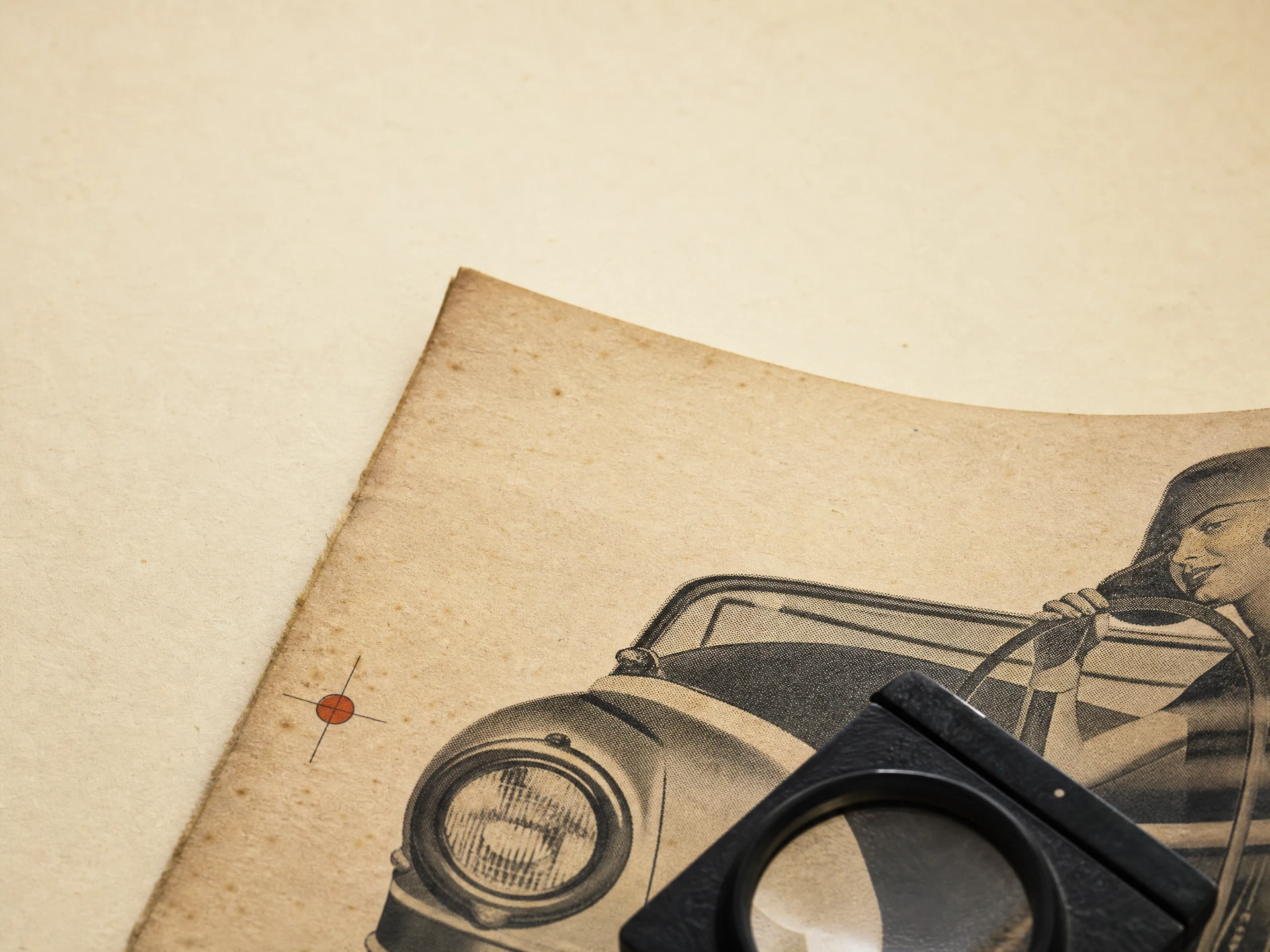
A faded magazine page, an advertisement clipped decades ago, or a piece of printed ephemera may show creases, foxing, softened edges, discoloration, or marks left by previous owners. These details are often described simply as signs of age, but together they form something more meaningful: a record of the object’s journey.
## Age Leaves Evidence
Paper changes naturally over time. Exposure to light, air, humidity, handling, and storage conditions slowly alters its surface and color.
A bright white page may become warm ivory. Edges may darken. Small brown spots known as foxing may appear. Fold lines become permanent, and areas repeatedly touched can develop a different texture.
No two pieces age in exactly the same way.
Even when two advertisements were printed in the same magazine on the same day, decades of separate ownership and storage can leave them looking entirely different today.
That individuality is part of what makes original vintage paper compelling.
## Patina Is Part of the Object
Collectors often use the word **patina** to describe the visible effects of age.
On paper, patina can include subtle yellowing, fading, tiny imperfections, worn edges, old folds, printing irregularities, and other changes that develop naturally over time.
These characteristics are not necessarily flaws to be removed.
For an authentic vintage piece, they can help distinguish an object that has genuinely survived through decades from a modern reproduction designed to look old.
A perfectly clean digital image can reproduce the artwork of an old advertisement. It cannot reproduce the physical history of the original sheet of paper.
## Every Mark Has a Possible History
A crease might suggest that a page was folded for storage.
A slightly worn corner may indicate years of handling.
A clean rectangular area surrounded by darker paper might reveal where another object once protected the surface from light.
A handwritten note may connect the piece to a previous owner.
Not every mark can be explained with certainty, and it is important not to invent a history that cannot be proven. But physical evidence allows us to observe how an object has changed and sometimes offers clues about the environments through which it passed.
This is one reason original ephemera can feel unusually personal. The object existed in the same physical world as the people who originally read, purchased, saved, or discarded it.
## Paper Was Never Meant to Last Forever
Many forms of printed ephemera were created for temporary use.
Magazine advertisements were intended to sell products. Catalog pages presented merchandise for a single season. Newspapers reported events of the day. Tickets, labels, brochures, packaging, and promotional inserts were often expected to be thrown away once their purpose had been served.
Their survival was rarely guaranteed.
When one of these objects remains intact fifty, seventy, or one hundred years later, its continued existence becomes part of its significance.
What was once ordinary can become historical simply because so much surrounding material disappeared.
## The Difference Between Image and Artifact
The image printed on a vintage page can often be scanned, photographed, and reproduced.
The artifact itself cannot.
Its paper stock, printing method, dimensions, texture, aging, imperfections, and physical wear belong to one specific object.
This distinction matters when collecting vintage print material.
A reproduction preserves an image.
An original preserves both the image **and the physical evidence of time**.
That physical evidence is what gives old paper much of its character.
## Imperfection Can Be the Story
Modern printing encourages consistency. Every copy is expected to look identical.
Vintage paper often offers the opposite experience.
Small variations remind us that these objects passed through real printing presses, distribution networks, shops, homes, libraries, offices, attics, boxes, and collections before reaching the present day.
A stain, softened edge, or faded section may reduce conventional ideas of perfection, yet increase the sense that the object has actually lived.
For collectors who value authenticity, those traces can be more interesting than a flawless surface.
## Reading Paper as Material History
Looking at old paper means looking beyond what was printed on it.
The typography tells us about design.
The advertisement tells us about commerce.
The language tells us about society.
The illustration tells us about visual culture.
And the paper itself tells us about time.
Together, these layers transform a simple printed page into a small historical object.
Old paper tells a story not because every stain or crease has a known explanation, but because its physical condition records something a reproduction never can:
**the passage of time itself.**