
From the archive
Before Photography : When Illustration Shaped the Printed World
Image and context
Article
# Before Photography: When Illustration Shaped the Printed World
Before photography became the dominant visual language of magazines and advertising, illustration did much of the work that cameras would later take over.
Products, fashion, travel, architecture, food, automobiles, people, and imagined lifestyles were all presented through the hands of illustrators.
For decades, the public did not simply look at photographs of the world.
They looked at a world interpreted through drawing and painting.
## Illustration Was Not Decoration
Today, illustration is often treated as one visual option among many.
In earlier print culture, it was frequently essential.
If a magazine needed to show a new dress, a luxury hotel, a motorcar, a household product, or a glamorous social scene, an illustrator could construct the image from scratch.
The result did not have to reproduce reality exactly.
It had to communicate an idea clearly and persuasively.
That made illustration especially powerful in advertising.
An illustrator could make a room brighter, a face more elegant, a product more desirable, and a lifestyle more aspirational than everyday reality.
## Artists Could Create What Cameras Could Not
Early photography came with limitations.
Exposure times could be slow. Equipment was cumbersome. Reproduction quality in print was inconsistent. Color photography was either unavailable, expensive, or impractical for many publications.
Illustrators had none of those restrictions.
They could combine several moments into one image.
They could place a product in an idealized setting.
They could invent lighting, exaggerate scale, simplify backgrounds, and direct the viewer's attention precisely where it was needed.
If reality was inconvenient, illustration could redesign it.
## Advertising Became a Form of Visual Storytelling
Many early advertisements did not simply display a product.
They created a scene.
A cigarette might appear in the hand of a sophisticated traveler.
A car might be shown on an empty coastal road.
A perfume bottle could be placed inside an imagined world of elegance and romance.
A household appliance might appear in an ideal family interior.
The product was often only one part of the composition.
The illustration sold the world surrounding it.
This approach made advertising closely connected to editorial illustration, poster design, theater, fashion drawing, and fine art.
## The Illustrator Had Enormous Control
Before photographic art direction became dominant, illustrators had remarkable influence over how people and products were represented.
Every element could be adjusted.
A gesture could be made more graceful.
Clothing could be made more dramatic.
The proportions of a product could be emphasized.
Backgrounds could disappear entirely if they distracted from the message.
The illustrator was not merely recording a scene.
The illustrator was constructing one.
That difference is fundamental.
## Fashion Illustration Created an Ideal World
Fashion was one of the fields where illustration remained especially important.
Before modern fashion photography became widespread, illustrated fashion plates and magazine drawings communicated silhouette, fabric, color, posture, and social identity.
These images often extended beyond literal documentation.
They presented an ideal of how clothing was meant to feel.
A dress could appear more fluid.
A figure could be elongated.
A gesture could become theatrical.
The image conveyed mood as much as information.
This is why historical fashion illustration can sometimes tell us more about the aspirations of an era than a straightforward photograph.
## Illustration Could Control Color
Color was another major advantage.
Before reliable mass-market color photography, illustrators and printmakers could create vivid color imagery through painted originals and carefully controlled printing processes.
The final printed result might involve lithography, chromolithography, offset printing, or other reproduction techniques depending on the period.
Even when the printing process imposed limitations, the illustrator could design with those limitations in mind.
Colors could be simplified, intensified, or strategically placed.
The image was created for print from the beginning.
## Not Every Image Was Drawn Directly for the Page
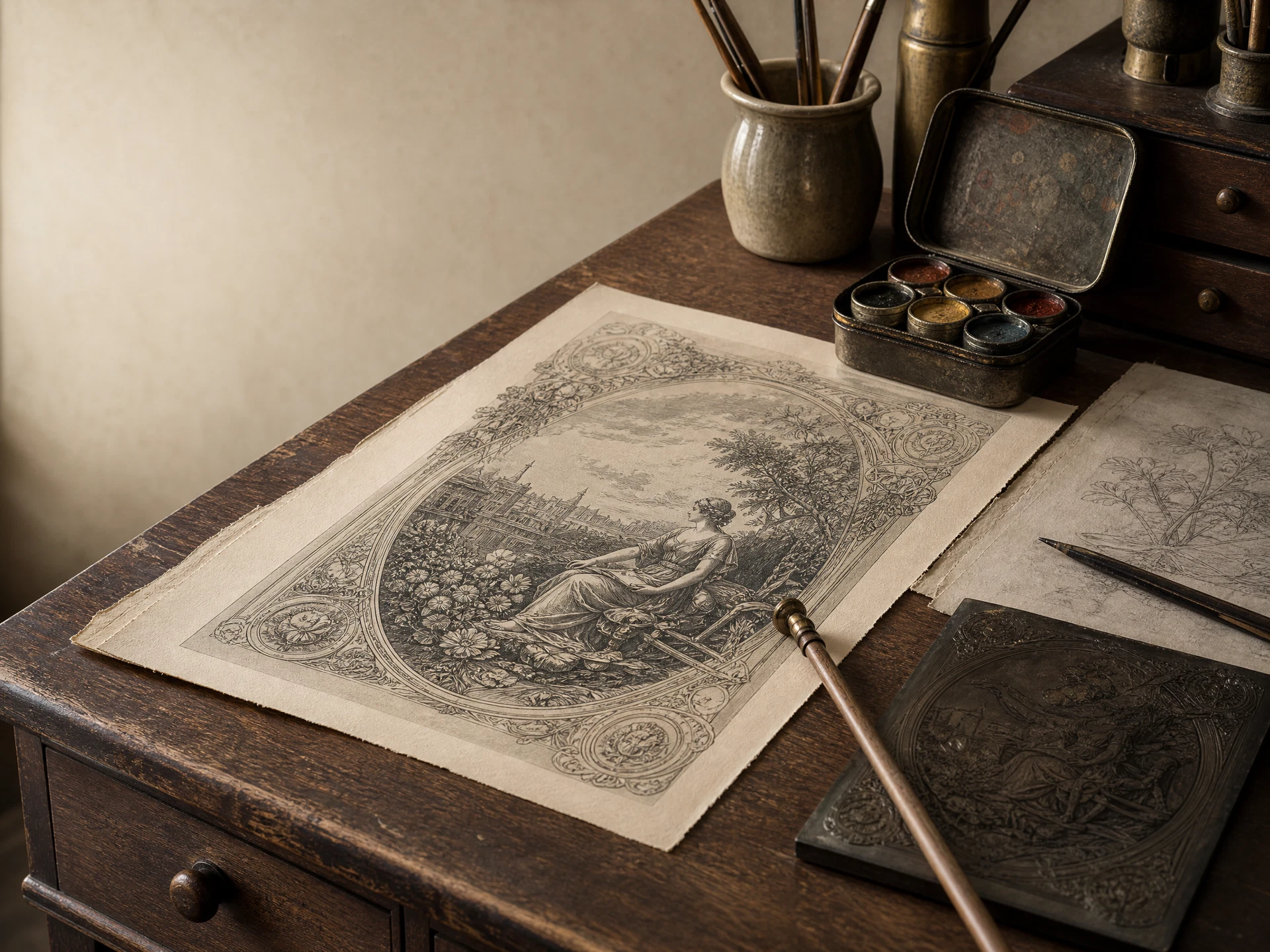
The artwork seen in an old magazine was often only the final stage of a much larger process.
An illustrator might first create an original painting, drawing, watercolor, or gouache.
That original artwork would then be photographed, separated, engraved, screened, or otherwise prepared for reproduction.
The printed image was therefore a translation of the artist's original work through a mechanical printing system.
By the time it reached the reader, the image had passed through several layers of craftsmanship and technology.
## Famous Illustrators Became Part of Brand Identity
Some illustrators became highly recognizable.
Their styles could help define magazines, advertising campaigns, and entire brands.
A particular treatment of the human figure, use of line, color palette, or composition could become immediately associated with a publication or advertiser.
In this sense, illustrators performed a role similar to photographers, art directors, and brand designers today.
Their personal visual language could become commercially valuable.
## Photography Did Not Replace Illustration Overnight
The rise of photography was gradual.
Illustration and photography coexisted for decades.
Some advertisements used photographs for the product but illustrations for the background.
Others combined drawn figures with photographic elements.
Certain categories continued to favor illustration long after photography became practical.
Fashion, cosmetics, travel, automobiles, food, and luxury goods all continued using illustration because it could create a controlled and idealized atmosphere that photography sometimes struggled to match.
The transition was not simply from drawing to camera.
It was a long period of experimentation between the two.
## Why Photography Eventually Became Dominant
As cameras improved, photography became faster, cheaper, more flexible, and easier to reproduce at high quality.
Printing technology also improved.
Photographs could increasingly be printed with better tonal range, sharper detail, and eventually convincing color.
Advertising culture began to value the apparent realism of photography.
Consumers could see what a product supposedly looked like rather than only an artist's interpretation.
By the mid-to-late twentieth century, photography had become dominant in many areas of commercial print.
But illustration never disappeared.
Its role changed.
## The Difference Is More Than Style
When we look at an illustrated advertisement from the early twentieth century, we are not simply looking at an older aesthetic.
We are looking at a different visual system.
The image was designed around the abilities of the artist rather than the capabilities of a camera.
Reality could be edited before it ever reached the page.
Light, anatomy, architecture, perspective, expression, and atmosphere were all subject to interpretation.
That gave illustrated print a distinctive quality.
It often shows us not exactly how the world looked, but how publishers and advertisers wanted the world to be imagined.
## Illustration Preserves the Imagination of an Era
Photographs preserve moments.
Illustrations often preserve ideals.
They show us how beauty was imagined, how luxury was represented, how technology was celebrated, and how everyday life was transformed into aspiration.
For collectors of vintage print, this makes illustrated material particularly valuable as cultural evidence.
The paper contains more than an image.
It preserves the collaboration between artist, printer, publisher, advertiser, and the visual expectations of the audience at that moment in history.
Before photography became the default language of commercial imagery, much of the printed world was drawn by hand.
And because of that, the past often reached its audience not exactly as it was—
but as someone imagined it should look.